
Showing posts with label week 10. Show all posts
Showing posts with label week 10. Show all posts
Friday, October 26, 2018
Famous Last Words: My First Last Words
I did have time to do both part A and B reading this week. I did the Eskimo/Inuit reading, and I remember the pictures more than anything. The pictures would be in black and white but they would always be wearing furry, home-made outdoor clothing. I did a lot of writing this week both inside and outside of this class. I think my best writing was for my microbiology class. We had to search for an article that was relatively new covering a topic we had previously gone over in lecture. I chose to write a summary and answer questions on a reading that involved probiotics being used in powder and pill form to help with facial acne. This was our first of three assignments for this class, and I really think writing my own stories every other week benefited my ability to write a short summary of an article! I use to just try and read the story/article and then write down my thoughts. Now I keep two tabs open and write notes to myself while I read and I think that technique has helped improve my writing a lot. I enjoy reading other people's storybook or portfolio projects. I ran into one covering a food blog and it was so well put together! My other classes are going pretty well. I think this is the calm before the storm of third semester tests followed by finals. I am worried about my ornithology class because we have to learn 150 birds from Oklahoma and be able to identify them for our final lab practical. We also have to write, and attempt to publish, a story over a neotropical bird of our choosing. My grandmother recently passed away, so next week I will be spending time with family as we celebrate her life. That means school has to get put on the back burner for a couple of days, but I am happy I will get to spend a few days with family.
 Image Information: Poem from The Star of Bethlehem (and other poems) by Frederick Edward Weatherly. Web Source: Flickr

Wednesday, October 24, 2018
Story Lab: EmpoWord
Showing how historians, chemists and musical composers use story telling in their work makes the reading more relate-able to a wide audience. I find myself wondering what happens to the 'flat characters' as described by the author in a lot of stories or even movies that I watch. I want to work on having a few more dynamic characters in my stories moving forward. I could achieve this by having more plot twists occur in my writing. Breaking the plot into scope, sequence and pacing makes it much easier to explain how to create a more interesting story line. I thought it was interesting when the author critiqued the typical five step story plot guide. They said you could start at an action scene and then introduce characters and set the story line. I usually go for the first person point of view when writing a story, but with my storybook project I have been using 3rd person omniscient. Choosing a word choice during dialogue for two characters is really important. The way they speak to each other can say a lot about their relationship. The most important idea I got from reading this chapter is that the first idea for writing that pops into your head is not the story you have to write about. It is okay to brainstorm until you find something you love. I really think reading this advice will benefit my stories in the weeks to come.


Bibliography: EmpoWord Chapter2: Telling a Story, Web Source: EmpoWord
Image Information: Writing Brainstorm, Web Source: flickr
Reading Notes: Eskimo Unit, Part B
'the blood poured from his clothes, and wherever they went, the snow was marked with blood' was very descriptive. I enjoyed the married woman's character a lot because she was willing to die to avenge her husband.
I loved the ending to this story. "Thus punishment falls upon the man who kills," is a strong way to reiterate the main point of the tale. I also enjoyed the included metamorphosis.
The attack on the village was very detailed. Navaranapaluk was punished for lying, but she sort of deserved that fate because she caused many women to die.
I thought it was interesting that two sisters were married to a whale and an eagle. I like the character choices in this story, but I was really confused at the end as to why the whale ended up in such bad shape.
I imagined a beautiful scene when the author was describing the houses and smoke holes in the story. The vibe of the story switches gears when the father rescues the son. I was afraid the people who took him would wake up.
When Atarssuaq attempted to throw his son in the water and let him learn to swim on his own, it reminded me of multiple movies I have seen where the father figure does this exact thing. A lot of these stories just tell if the characters have a strong relationship, but this author gives the background of why the father and son are so close.
I had to imagine a lot of the scenery in the story about Saunikoq and Tungujuluk on my own. I felt like the author could have added descriptions about the sea when either characters were out hunting.
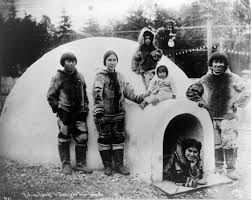 Image Information: Inuit Family and their Igloo, Web Source: Wikimedia Commons
Bibliography: Eskimo Folk-Tales by Knud Rassmussen, Web Source: Eskimo Unit
I loved the ending to this story. "Thus punishment falls upon the man who kills," is a strong way to reiterate the main point of the tale. I also enjoyed the included metamorphosis.
The attack on the village was very detailed. Navaranapaluk was punished for lying, but she sort of deserved that fate because she caused many women to die.
I thought it was interesting that two sisters were married to a whale and an eagle. I like the character choices in this story, but I was really confused at the end as to why the whale ended up in such bad shape.
I imagined a beautiful scene when the author was describing the houses and smoke holes in the story. The vibe of the story switches gears when the father rescues the son. I was afraid the people who took him would wake up.
When Atarssuaq attempted to throw his son in the water and let him learn to swim on his own, it reminded me of multiple movies I have seen where the father figure does this exact thing. A lot of these stories just tell if the characters have a strong relationship, but this author gives the background of why the father and son are so close.
I had to imagine a lot of the scenery in the story about Saunikoq and Tungujuluk on my own. I felt like the author could have added descriptions about the sea when either characters were out hunting.

Bibliography: Eskimo Folk-Tales by Knud Rassmussen, Web Source: Eskimo Unit
Monday, October 22, 2018
Reading Notes: Eskimo Folk Tales, Part A
The first story had a very descriptive paragraph describing children crawling from the bushes. I thought 'only water would burn' and 'no day ever dawned' were examples of beautiful word usage.
I loved that people kept making a place for the bear in their community as it grew older and stronger. The relationship between him and the foster mother was a strong one.
The story about the boy with a house full of ghosts took a lot of my own imagining.
I enjoyed the way the author described the scene when Isigaligarssik shot the arrow.
'The sun was just over the houses of the village' is a really pretty description. I wonder about the relationship between the insects and the wife in this story.
The author of Atungait did a great job including natural imagery, but I found myself wondering more about their trips. I am really curious to know what foothall is.
I felt like I had to imagine what the giant dogs and people in the final story looked like on my own. So I imagined a Great Pyrennes.
 Image Information: Great Pyrennes, Web Source: Wikipedia
Bibliography: Eskimo Folk-Tales by Knud Rassmussen, Web Source: Eskimo Unit
I loved that people kept making a place for the bear in their community as it grew older and stronger. The relationship between him and the foster mother was a strong one.
The story about the boy with a house full of ghosts took a lot of my own imagining.
I enjoyed the way the author described the scene when Isigaligarssik shot the arrow.
'The sun was just over the houses of the village' is a really pretty description. I wonder about the relationship between the insects and the wife in this story.
The author of Atungait did a great job including natural imagery, but I found myself wondering more about their trips. I am really curious to know what foothall is.
I felt like I had to imagine what the giant dogs and people in the final story looked like on my own. So I imagined a Great Pyrennes.


Bibliography: Eskimo Folk-Tales by Knud Rassmussen, Web Source: Eskimo Unit
Subscribe to:
Posts (Atom)